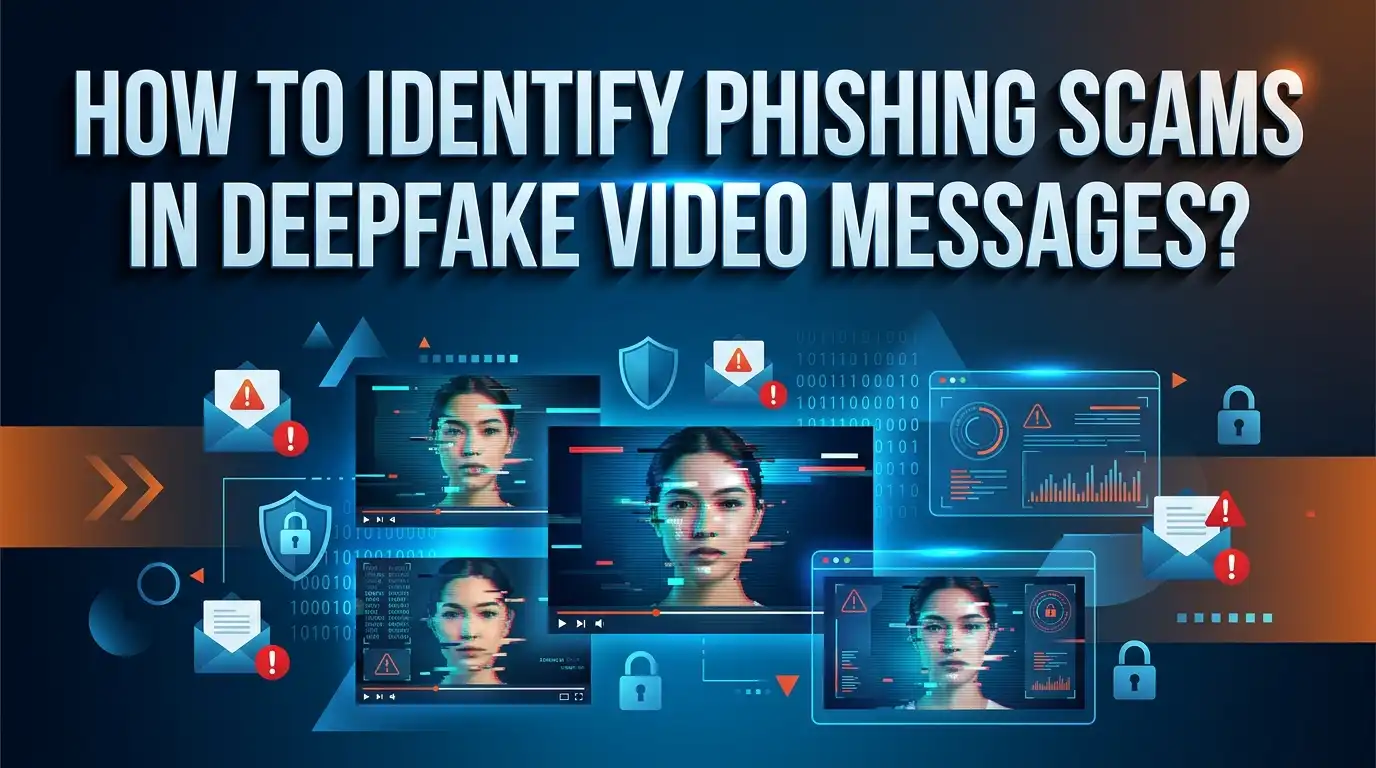
How To Identify Phishing Scams in Deepfake Video Messages?
Imagine this. Your boss appears on a video call and asks you to wire money immediately. The face is familiar. The voice sounds real. But something feels a little off. You may have just encountered a deepfake phishing scam, and if you act without thinking, you could lose thousands or even millions of dollars.
Deepfake phishing is one of the fastest growing cyber threats today. AI generated video and audio scams increased by over 3,000% in recent years. The FBI has warned about the rapid rise of synthetic media fraud.
Businesses lost an average of nearly $500,000 per deepfake incident in 2024. One company in Hong Kong lost $25 million from a single fake video conference call. These attacks fool smart people every day because the technology is now shockingly convincing.
You do not need to be a cybersecurity expert to protect yourself. This guide gives you clear, step by step methods to spot deepfake video phishing scams. Every tip here is practical and ready to use right now.
In a Nutshell
- Deepfake phishing scams use AI to clone real people’s faces and voices in video messages. Scammers use this technology to impersonate bosses, coworkers, family members, and public figures. The goal is almost always to trick you into sending money, sharing passwords, or revealing sensitive data.
- Visual red flags include unnatural blinking, blurry face edges, and lighting that does not match the background. These small details are often the first signs that a video has been manipulated by AI. Training yourself to notice them takes only a little practice.
- Audio clues are just as important as visual ones. Listen for flat or robotic voice tones, missing breathing sounds between sentences, and lip movements that do not match the words being spoken. Real human speech has natural imperfections that AI still cannot fully copy.
- Always verify identity through a separate communication channel before acting on any urgent or unusual request. Call the person on a known phone number, text them on a different app, or confirm face to face. Never rely on the video message alone.
- Free and paid deepfake detection tools exist today that can analyze suspicious videos and flag manipulated content. Tools like Deepware, Sensity AI, and Reality Defender provide extra layers of protection for individuals and businesses.
- Building good security habits at home and work is your strongest defense. Establish family code words, create workplace verification protocols, and practice regular security awareness training. These simple steps can prevent even the most convincing deepfake scam from succeeding.
What Is a Deepfake Phishing Scam and How Does It Work
A deepfake phishing scam combines two dangerous technologies. Deepfake AI creates synthetic video and audio that mimics a real person. Phishing is the social engineering tactic that tricks victims into taking harmful actions like sending money or sharing login credentials.
Here is how it works in practice. A scammer collects photos, videos, and audio clips of a target person. These come from social media profiles, YouTube videos, public webinars, or even stolen messenger accounts. The scammer feeds this material into AI tools that learn the person’s facial structure, expressions, and voice patterns.
The AI then generates a realistic video or audio message that looks and sounds like the real person. Modern voice cloning tools need as little as three seconds of audio to produce a convincing clone. The scammer sends this fake message through email, a messaging app, or even a live video call.
The message almost always creates a sense of urgency. Typical scenarios include a boss demanding an immediate wire transfer, a family member claiming an emergency, or a colleague asking for sensitive account access. The pressure to act fast is what prevents victims from stopping to verify the request.
What makes these scams so dangerous is their believability. Research shows that humans correctly identify high quality deepfake videos only about 24.5% of the time. That means roughly three out of four people cannot tell the difference between a real video and a fake one. Understanding this threat is the first step to defending against it.
Why Deepfake Phishing Scams Are Growing So Fast
The explosion of deepfake scams is not accidental. Several factors have come together to create a perfect environment for this type of fraud.
The cost of creating a deepfake has dropped to nearly zero. Open source AI tools and cheap online services let anyone generate synthetic video and audio for just a few dollars. The deepfake robocall that impersonated a U.S. president during the 2024 New Hampshire primary cost only $1 to create and took less than 20 minutes to produce.
The volume of deepfake content online has skyrocketed. Deepfake files surged from around 500,000 in 2023 to a projected 8 million by 2025. That is a growth rate of roughly 900% per year. Fraud attempts using deepfakes increased by 3,000% in 2023 alone, with North America seeing a 1,740% increase.
Social media gives scammers easy access to raw material. Every public photo, video, and voice recording you post online can be used as training data for deepfake AI. The more content available, the more realistic the fake becomes.
Businesses are dangerously unprepared. About 80% of companies report having no protocols or response plans for deepfake attacks. More than half of business leaders say their employees have received zero training on recognizing deepfakes. One in four executives admits to having little or no familiarity with the technology.
This combination of cheap tools, abundant source material, and organizational unreadiness has turned deepfake phishing into one of the most profitable forms of cybercrime in the world today.
Visual Red Flags That Reveal a Deepfake Video
Your eyes are your first line of defense. Deepfake technology has improved dramatically, but AI still struggles with certain visual details. Knowing what to look for gives you a real advantage.
Watch the eyes carefully. Deepfake subjects often blink in unnatural patterns. Some blink too rarely. Others blink too rapidly or unevenly, with one eye slightly out of sync with the other. Look for a “glassy” or lifeless quality in the eyes. In real video, the reflections in both eyes match the environment. In deepfakes, these reflections often differ between the left and right eye.
Check the edges of the face. The boundary where the face meets the hair, ears, and neck is a weak spot for AI. You may notice blurring, flickering, or strange color shifts along the hairline. The jawline and ears are especially prone to visual glitches.
Examine the lighting and shadows. Real light behaves consistently. If the shadows on a person’s face do not match the light sources visible in the background, you may be looking at a deepfake. Watch for skin that looks unusually smooth or has an odd sheen that does not fit the setting.
Notice facial expressions. Deepfakes often produce expressions that feel slightly frozen or exaggerated. Fine wrinkles and natural facial folds that appear during real emotions are frequently absent. A smile that looks plastered on or emotions that do not match the conversation topic are strong warning signs.
Pay attention to the background too. In generated videos, the background may look too blurry, remain static when the camera moves, or contain objects that do not interact naturally with the person on screen.
Audio Clues That Expose Fake Voice and Speech
Listening carefully is just as important as looking carefully. AI voice cloning has become very convincing, but it still leaves behind detectable traces if you know what to listen for.
Pay attention to the overall tone of voice. Synthetic voices often sound unusually flat or lack the natural ups and downs of real speech. There may be a subtle electronic or metallic quality to the voice that feels slightly “off” even if you cannot pinpoint exactly why. Real human voices carry warmth, texture, and slight imperfections that AI still struggles to replicate.
Listen for breathing. This is one of the most reliable audio indicators. Real people take micro pauses to breathe between phrases. They occasionally cough, clear their throat, or sniff. Many deepfake audio clips lack these natural sounds entirely, or place them at odd moments that do not fit the rhythm of the speech.
Check the lip sync. Even high quality deepfakes can show a slight delay between lip movements and spoken words. A mismatch of even 100 to 300 milliseconds is noticeable to the human ear when you focus on it. Pay particular attention when the speaker pronounces sounds like “m,” “f,” or “t,” which require very specific lip shapes.
Notice speech patterns and habits. Every person has unique verbal habits, favorite phrases, accent features, and speech rhythms. If someone you know well suddenly sounds slightly different in these ways, treat it as a warning sign. Scammers can clone the basic sound of a voice but often miss these personal quirks.
If a video or audio message arrives with poor quality and the sender blames it on a bad connection, be extra cautious. Scammers deliberately reduce video and audio quality to hide the visual and audio flaws that would otherwise reveal a deepfake.
Behavioral Tests You Can Use During a Live Video Call
If you suspect that a live video call might involve a deepfake, you can run simple tests in real time. These behavioral challenges push the AI beyond its limits and often cause the fake to break down visibly.
Ask the person to turn their head fully to the side. Most deepfake models are trained on frontal photos and videos. A full profile view causes the AI generated face to distort, warp, or break apart. This is one of the most effective tests available today. AI startup Metaphysic, known for creating viral deepfakes, confirms that head rotation remains the most reliable way to expose a fake.
Request spontaneous physical actions. Ask the person to wave a hand in front of their face, touch their nose, pick up an object, or take a sip from a cup. Deepfake AI has difficulty handling hands that interact with the face. You may see fingers pass through the face like a ghost, or the hand may appear distorted and unnatural.
Ask a personal question only the real person could answer. This is a powerful social test. Ask about a shared experience, a private joke, or a specific detail from a past conversation. Questions like “What did we talk about at lunch yesterday?” or “What is our project deadline this Friday?” force the scammer to reveal their ignorance.
Request screen sharing. In a work setting, ask the caller to share their screen and show a specific file or document. Without access to your real colleague’s computer, a scammer cannot fulfill this request.
These tests cost nothing and require no technology. They work because current deepfake AI cannot improvise the way a real human can. If the person on the call resists or avoids these simple requests, treat that resistance as a red flag.
The Second Channel Rule: Your Most Powerful Defense
If you remember only one piece of advice from this entire guide, let it be this: always verify through a second channel. This single habit can stop almost every deepfake phishing scam, no matter how convincing the fake appears.
Here is how the second channel rule works. When you receive a suspicious video message or an unusual request via video call, you stop and contact the sender through a completely different communication method. If the request came via Zoom, call the person’s mobile phone number that you already have saved. If it came through a messaging app, send a separate email or text through a different platform.
Never use contact information provided in the suspicious message itself. Scammers often include callback numbers or links that route to them, not the real person. Always use a phone number or email address you already have stored in your contacts or your company directory.
This approach works because it separates the verification process from the attack channel. Even a perfect deepfake cannot survive when you pick up the phone and call the real person directly. The $25 million fraud at engineering firm Arup could have been prevented if just one employee had called the real CFO on a trusted number before processing the wire transfer.
Make this a habit in both your personal and professional life. If a family member sends a video asking for emergency money, call them back on their known number first. If a boss requests a sensitive action via video, confirm it through your company’s internal systems. The few minutes this takes could save you from devastating financial loss.
How To Set Up Verification Protocols at Work
Workplace verification protocols are structured steps that remove individual guesswork from the process. They create a consistent system where every unusual request gets checked before anyone takes action.
Start with a mandatory callback policy. Any request involving money transfers, sensitive data sharing, or system access changes must be verified through a direct phone call to the requester. The call must use a phone number stored in your company’s internal directory, not a number provided in the original request. This simple rule blocks the most common deepfake scam scenario.
Implement a two person approval system for financial transactions. No single employee should have the authority to authorize large payments based on a video call or message alone. Require at least two authorized approvers who must independently verify the request before funds move. This dual control mechanism adds a layer of protection that deepfake scammers cannot easily bypass.
Create a rotating passphrase system for high value teams. Executive leadership, finance, and IT teams should share a verbal passphrase that changes weekly or monthly. Before executing any sensitive request received via video or voice, the requester must state the current passphrase. Keep this passphrase secret and do not write it down in digital systems that could be compromised.
Document and communicate these protocols clearly. Every employee should know the exact steps to follow when they receive an unusual request. Post the verification procedure in common areas. Include it in onboarding materials. Review it in team meetings. A protocol that people do not know about or do not understand is a protocol that will not protect you.
Test these protocols regularly with simulated scenarios to make sure people follow them under pressure.
Deepfake Detection Tools You Can Use Right Now
Technology can supplement your own observation skills. Several tools are available today that analyze video and audio content for signs of AI manipulation. Some are free, and others offer paid enterprise plans with advanced features.
Deepware Scanner is a free online tool that lets you upload or link a suspicious video for analysis. It scans the content for known deepfake artifacts and provides a confidence score indicating whether the video appears genuine or manipulated. This is a good first step for checking a video message you received through email or a messaging app.
Sensity AI offers both consumer and enterprise solutions for detecting deepfakes across images, video, and audio. Their platform uses multiple detection methods and can flag AI generated content with high accuracy. Businesses that handle sensitive customer interactions or financial transactions find this type of tool especially valuable.
Reality Defender provides real time enterprise defense. It offers browser plugins and API integration that can scan video content as it arrives. For organizations that conduct frequent video meetings, this type of continuous monitoring adds an important safety layer.
Hive Moderation specializes in AI generated content detection across multiple media types. Their system can identify synthetic video, images, and text, which makes it useful for organizations that need to verify content across different formats.
For personal use, free tools like Deepfake Detection IO offer basic scanning capabilities for images, videos, and voice recordings. While these tools are not perfect, they provide a helpful additional check when you are unsure about a piece of content.
No detection tool is 100% accurate. Research shows that detection accuracy can drop by up to 50% when tools encounter new types of deepfakes they were not trained on. Use these tools as one layer in your defense, not as your only protection.
How To Protect Your Family From Deepfake Scams
Deepfake scams do not target only businesses. They hit families hard, especially when scammers impersonate loved ones in emergency scenarios. Protecting your family requires a few simple but effective steps.
Create a family code word. Choose a secret word or phrase that only your family members know. If anyone receives a video or audio message from a family member claiming an emergency and requesting money, the first response should be to ask for the code word. A real family member will know it instantly. A scammer using a deepfake will not.
Limit the personal content you share publicly online. Every photo, video, and voice recording you post on social media can be used as source material for a deepfake. Set your profiles to private. Restrict who can see your posts. Be especially careful with videos that clearly show your face and include your voice, as these give scammers exactly what they need to create a convincing clone.
Educate vulnerable family members. Elderly relatives, teenagers, and anyone less experienced with technology are prime targets. Sit down with them and explain how deepfake scams work. Show them examples of deepfake videos so they understand what to look for. Make sure they know to never send money based on a video or voice message alone without first verifying through a separate call.
Teach the pause and verify habit. The single most important lesson for any family member is to stop and check before acting. Scammers rely on panic and urgency to prevent victims from thinking clearly. Remind your loved ones that a real family member will always understand if you take two extra minutes to call them back and confirm.
Practice the family code word occasionally so everyone remembers it. Keep the conversation about online safety ongoing rather than treating it as a one time discussion.
What To Do If You Suspect You Are Watching a Deepfake
The moment suspicion strikes, you need a clear plan of action. Hesitation or confusion in that moment is exactly what scammers count on. Follow these steps to protect yourself.
First, do not act on the request. No matter how urgent the message seems, pause. Do not transfer money. Do not share passwords. Do not click any links. Do not download any files. The urgency itself is a manipulation tactic designed to bypass your judgment.
End the call or stop watching the video. If you are on a live call, politely say you need to step away and will call back in a moment. If you are watching a recorded video message, close it. Do not respond to follow up messages from the same source.
Contact the real person through a trusted channel. Call them on a phone number you already have saved. Message them on a different platform. If possible, speak with them face to face. Confirm whether they actually sent the message or made the request.
Report the incident immediately. If this happened at work, alert your IT security team or manager right away. Provide the meeting details, the time of the call, and a description of what made you suspicious. If this happened in your personal life, warn the person who was impersonated so they can check if their accounts have been compromised.
Save evidence if possible. Take screenshots, note the sender’s details, and save any links or files associated with the suspicious message. This information can help security teams or law enforcement investigate the incident.
File a report with the FBI’s Internet Crime Complaint Center (IC3) at ic3.gov if you are in the United States. Other countries have similar cybercrime reporting portals. Reporting helps authorities track these scams and warn others.
How Companies Can Train Employees To Recognize Deepfakes
Employee training is the single most effective way to reduce deepfake phishing risk in an organization. But the training must go beyond awareness posters and annual slide decks. It needs to be hands on and ongoing.
Run deepfake simulation exercises. Present employees with short video clips that include subtle AI generated flaws and challenge them to identify the fakes. This type of practical exercise builds real recognition skills that stick in memory. Safe exposure to convincing deepfakes under controlled conditions prepares people to detect real attacks under pressure.
Teach the specific visual, audio, and behavioral red flags. Do not assume employees will figure out what to look for on their own. Walk through concrete examples of unnatural blinking, mismatched lighting, flat voice tones, missing breathing sounds, and lip sync errors. Use real deepfake samples in training sessions so people see actual examples rather than just reading about them.
Create and rehearse a clear escalation playbook. Every employee should know the exact steps to follow when they suspect a deepfake. The playbook should be three steps: flag the issue, isolate the suspicious participant, and escalate to the security team through a trusted channel. Simplicity matters because complex procedures get ignored under stress.
Measure and track training effectiveness over time. Track metrics like how fast employees report suspicious simulations, what percentage correctly identify deepfakes, and how well they retain knowledge between training sessions. Use these numbers to identify gaps and improve future training.
Make training continuous, not annual. The technology behind deepfakes evolves rapidly. Quarterly training sessions with updated examples keep employees sharp and aware of the latest tactics scammers are using.
Why You Should Never Trust Urgency in a Digital Message
Urgency is the engine that drives almost every deepfake phishing scam. Understanding why scammers use it and learning to resist it is one of the most important skills you can develop.
Scammers create urgency because it disables critical thinking. When you believe something must happen immediately, your brain shifts into reactive mode. You skip the steps you would normally take to verify a request. This is exactly what the attacker wants. Phrases like “I need this done in the next ten minutes” or “We will lose the deal if you do not act now” are designed to short circuit your judgment.
Real emergencies almost never require you to bypass security procedures. A legitimate boss will understand if you take five minutes to verify a transfer request. A real family member will not panic if you call them back before sending money. Any person who insists you must act immediately without any verification is creating artificial pressure, and that pressure itself is evidence of a scam.
Train yourself to treat urgency as a warning signal rather than a call to action. When you feel the rush of “I must do this right now,” let that feeling trigger your verification habit instead. Pick up the phone. Call the person directly. Confirm the request through a separate channel.
This applies equally to personal and professional situations. At work, follow your company’s verification protocol no matter how urgent the request appears. At home, use your family code word and call back on a known number. The few minutes of delay will never cost you as much as falling for a deepfake scam.
Practice this mindset regularly. The more automatic your “pause and verify” response becomes, the harder it will be for any scammer to manipulate you through urgency.
How Deepfake Scams Will Evolve and How To Stay Ahead
Deepfake technology will continue to improve. The fakes will become more realistic, harder to detect visually, and easier to produce at scale. Staying protected requires understanding where this threat is heading.
Real time deepfakes are already here and getting better. Scammers can now swap faces and clone voices during live video calls, not just in pre recorded messages. As AI processing power increases, these live fakes will become even smoother and more difficult to distinguish from real people. The visual and audio artifacts that reveal today’s deepfakes may disappear in future versions.
Multi person deepfake calls are becoming more common. The $25 million fraud at Arup involved a video conference with multiple AI generated participants. This means you cannot simply rely on the presence of other known colleagues on a call as proof that the meeting is legitimate. Every participant in a suspicious call should be independently verified.
AI detection tools are improving alongside the threats. Organizations like NIST and DARPA are investing heavily in deepfake detection research. Commercial tools are adding real time scanning capabilities that can flag suspicious video during live calls. Staying current with these tools and updating them regularly will be important.
Legislation is catching up. The EU AI Act now requires labeling of AI generated content. The U.S. TAKE IT DOWN Act criminalizes certain types of deepfake abuse. The UK Online Safety Act places new responsibilities on platforms. These laws create legal consequences for deepfake scammers and give victims avenues for reporting.
Your best long term strategy is a layered defense. Combine personal awareness skills, verification protocols, detection technology, and organizational training. No single method will stop every deepfake scam, but together they create a defense that is extremely difficult for any scammer to overcome.
Frequently Asked Questions
Can deepfake video messages fool facial recognition systems?
Yes. Deepfake technology can fool many facial recognition and identity verification systems. Research shows that face swap attacks against biometric systems increased by over 700% in 2023. Scammers use virtual cameras and AI generated face overlays to bypass liveness detection checks. This is why multi factor authentication is critical and why organizations should never rely on video identity alone for sensitive actions.
How much audio does a scammer need to clone someone’s voice?
Modern AI voice cloning tools can produce a convincing match from as little as three to five seconds of clear audio. This source material can come from social media videos, podcast appearances, conference recordings, or even a brief phone call. The more audio available, the more accurate the clone becomes. Limiting public audio of your voice reduces this risk.
Are free deepfake detection tools accurate enough to rely on?
Free tools like Deepware Scanner and Deepfake Detection IO provide useful initial analysis, but they are not foolproof. Detection accuracy can drop significantly when tools encounter new types of deepfakes they were not trained on. Use free tools as one layer of your defense, not as your only protection. Combine them with visual and audio observation skills and the second channel verification method.
What should I do if I already sent money after a deepfake scam?
Contact your bank or payment provider immediately and request a transaction reversal. Report the fraud to law enforcement through the FBI’s IC3 portal at ic3.gov if you are in the United States. Alert the person who was impersonated so they can check for account compromise. Document everything, including screenshots, transaction records, and communication logs. Act as fast as possible because speed increases the chance of recovering funds.
Can deepfake scammers impersonate someone on a live video call?
Yes. Real time deepfake technology allows scammers to swap their face with another person’s likeness during a live video call. They can also clone the target’s voice simultaneously. This is exactly how the $25 million Arup fraud was carried out. Always verify unusual requests through a separate channel, even if the person on the video call looks and sounds exactly like someone you know.
How do I teach children to recognize deepfake scams?
Start with age appropriate conversations about online safety. Explain that videos and voices can be faked by computers and that not everything they see online is real. Create a family code word and practice using it. Teach them to never share personal information or respond to urgent requests from anyone online without first talking to a trusted adult. Keep these conversations ongoing as the technology continues to change.

Hi, I’m Suzy — the voice behind RapidGenLab. I’m a tech enthusiast who loves breaking down complex products into simple, honest reviews and comparisons. Got a question? Feel free to reach out!